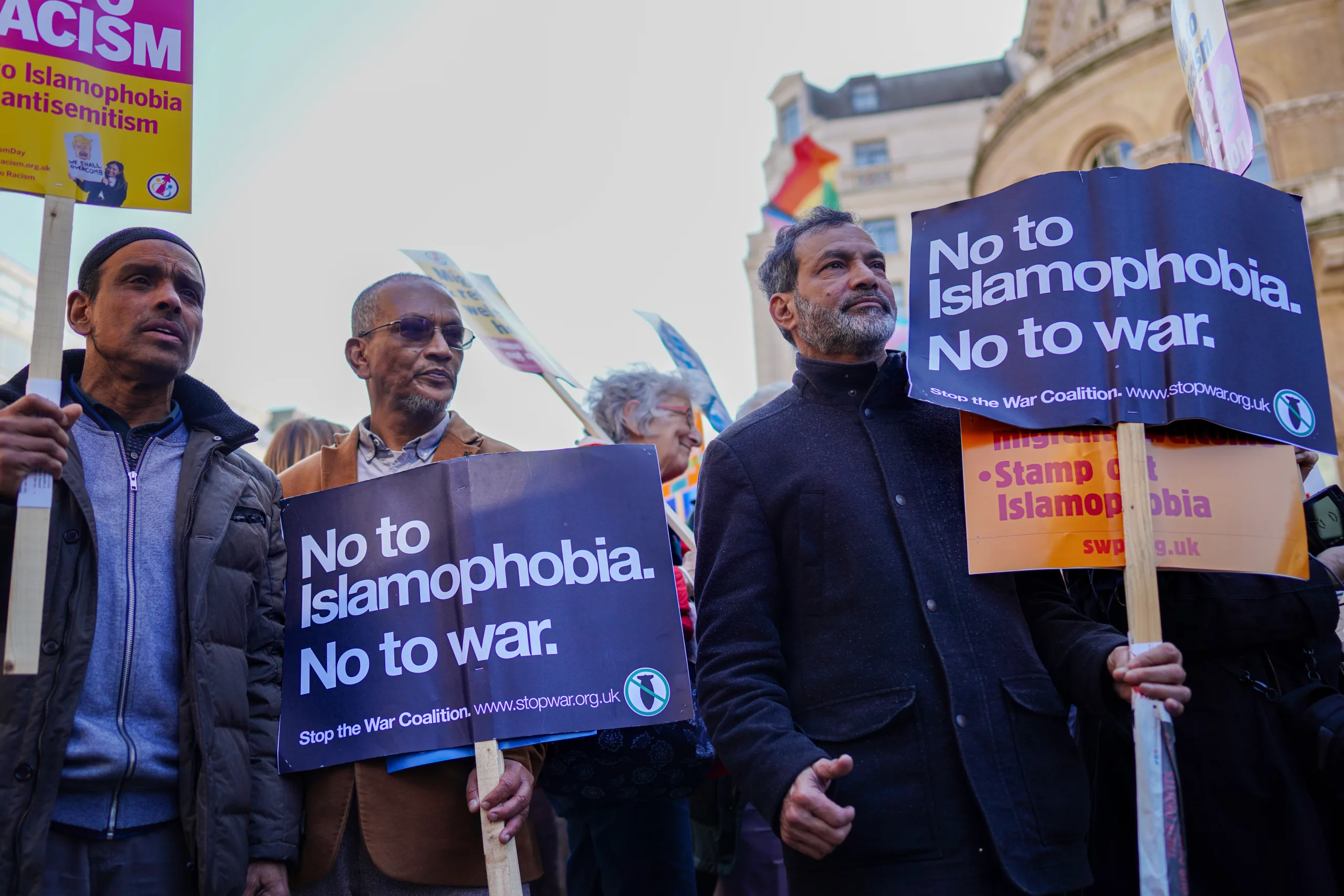
The tragic shooting at the Islamic Center of San Diego is a stark reminder that anti-Muslim rhetoric has real and dangerous consequences. ISPU’s American Muslim Poll 2025 documents a sharp rise in Islamophobia nationwide, with increasing anti-Muslim sentiment reported across nearly every demographic measured. ISPU’s research also shows that endorsing anti-Muslim stereotypes is directly linked to support for violence against civilians. Bigotry does more than divide communities — it endangers lives.
Researching family and wellness and building community capacity
Building Understanding
Protecting American pluralism and quantifying Muslim contributions
Providing Thought Leadership
Offering platforms for discussion and informing national conversations
How We Create Impact
Discover
We conduct rigorous, objective research on issues impacting American Muslims using a variety of methods.
Educate
We translate research into accessible resources, toolkits, and educational materials for diverse audiences.
Equip
Our strategy of equipping leaders multiplies our impact as the data lives on in the work of those who catalyze change.
ISPU in the News
From national outlets to local reporting, journalists rely on ISPU research and experts to inform stories about Muslim communities in the United States.
I remember the first time I learned ISPU’s facts and data about American Muslims and anti-Muslim discrimination, and the impact it had on my own understanding of the ways that anti-Muslim bigotry shows up in our country. It completely shifted my paradigm of what it means to love my Muslim neighbors from one of charity to mutual solidarity. It helped me to see the role that I have to play from where I’m situated, understanding that my own sense of freedom and dignity is tied to that of my Muslim neighbors.
- Becca Tyvoll, Partnerships and Program Coordinator, Shoulder to Shoulder Campaign
ISPU provides objective research and education about American Muslims to support well-informed dialogue and decision-making. This work is made possible in part through the support of generous individuals.
Amal Killawi is a clinical social worker, researcher, and community educator. She serves as a research fellow with the Family & Youth Institute and scholar with the Institute
Dr. Sana Malik is an Assistant Professor at the Stony Brook University School of Social Welfare and an expert in disparities research. She has served as a consultant
Halima Al-Khattab is an experienced health behavior researcher and community leader with a demonstrated history of working in academic, clinical, and community settings. Al-Khattab is skilled in nonprofit
Engy Abdelkader is an award-winning attorney and scholar who has worked with Muslims, Arabs and South Asians since 9/11 to address Islamophobia. Her research and writing explores religious
Nazita Lajevardi is a political scientist and attorney working primarily in race, ethnic politics, and American politics. Dr. Lajevardi’s research lies at the intersection of religion, race, ethnic
Dr. Ayaz Hyder is an Associate Professor in the College of Public Health and Core Faculty in the Translational Data Analytics Institute at The Ohio State University. Dr.
Dr. Nadia Ansary received her BA in Psychology (and Biology) from Rutgers University and her PhD in Developmental Psychology from Teachers College, Columbia University. Her background is in
Kristine J. Ajrouch, PhD, is Professor of Sociology at Eastern Michigan University. She is also Adjunct Research Professor at the Institute for Social Research at the University of
Dr. Muhammad Khalifa is a Professor of Educational Administration and Executive Director of Urban Education at Ohio State University. He is an internationally renowned educational leadership scholar, and
Ben Herzig is a Scholar at ISPU and is a psychologist in private practice in the Boston area. He received his doctorate in Clinical Psychology from Antioch University
Nancy A. Khalil completed her PhD in Anthropology at Harvard University and is currently a Postdoctoral Fellow at Yale’s Center on Race, Indigeneity and Transnational Migration. Her research
Saeed A. Khan is currently in the Department of History and Lecturer in the Department of Near East & Asian Studies at Wayne State University-Detroit, Michigan, where he
Maryam Razvi Padela is an educator and researcher. Her particular interests include investigating pedagogy used while teaching and learning about religion. Her dissertation was titled “The Representation and
Dr. Tasneem Siddiqui is a Visiting Assistant Professor in the Department of History, Politics, and Social Justice at Winston-Salem State University. She was an ISPU Fellow and the
Altaf Husain serves as an Associate Professor and chair of the Community, Administration and Policy Practice concentration in the Howard University School of Social Work, in Washington DC.
Dr. Sahar Khamis is an associate professor in the Department of Communication at the University of Maryland, College Park. She is an expert on Arab and Muslim media,
What Can You Do?
ISPU is a nonprofit organization that relies on the generosity of individual donors to keep our research free and accessible to everyone who needs it. You can help us keep it that way.
ISPU is a nonprofit organization that relies on the generosity of individual donors to keep our research free and accessible to everyone who needs it. You can help us keep it that way.
A new report by the Institute for Social Policy and Understanding (ISPU) examines the extent to which Hindu nationalism, or Hindutva, resonates among U.S.
Conducted by the Institute for Social Policy and Understanding (ISPU) in partnership with Stanford’s Muslim Mental Health and Islamic Psychology Lab, this qualitative study